Shaping Music for Dramatic Scenes
Explore different methods to adapt your own music for film and games. We will study timing, arrangement, and mood to help you become a more flexible composer.
- "Learn immediately applicable harmonic theories behind modern film and video game music"
- "Focused on selected topics most practical to modern media music composers"
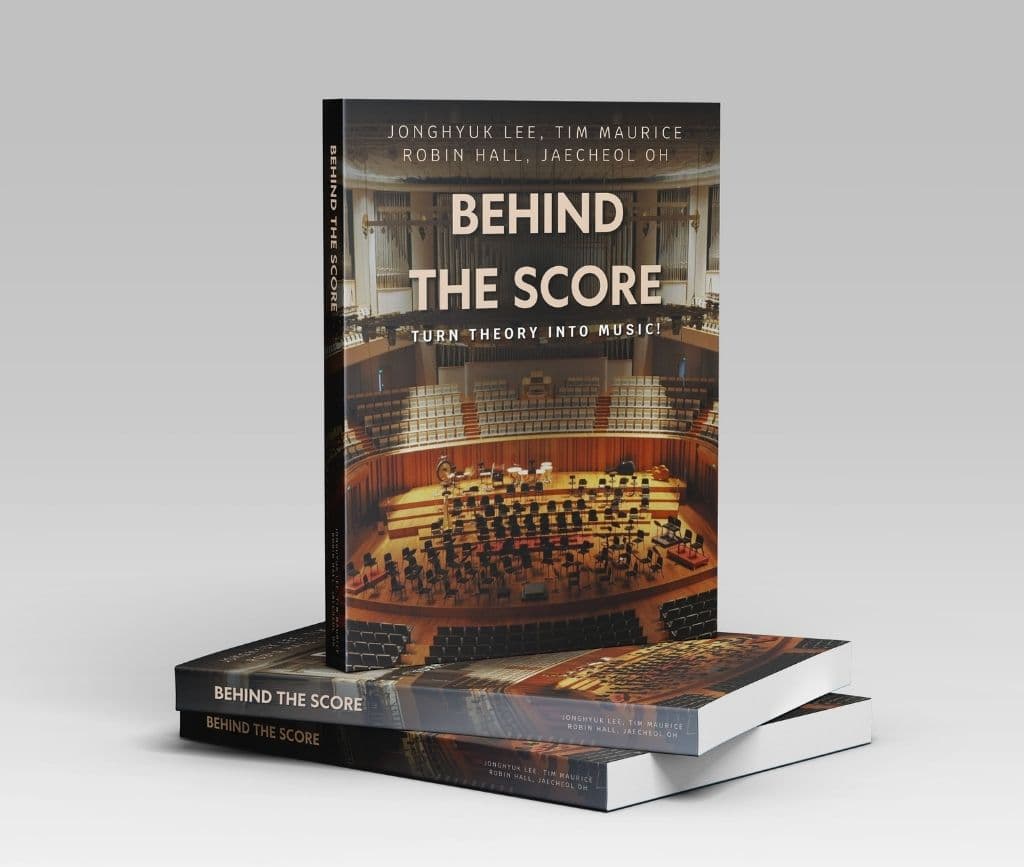
We’re pleased to announce that "Behind the Score" has been selected as a college textbook by the University of Westminster, UK.
- We are proud to be accepted as an official sponsor of Sonuscore's Composer of the Year 2025 contest .
We’re excited to introduce our brand-new course, Shaping Music for Dramatic Scenes, marking our first release in two years since the Behind the Score series. Through practical examples, this course shows how one piece of music can be adapted to fit different dramatic contexts.
Explore different methods to adapt your own music for film and games. We will study timing, arrangement, and mood to help you become a more flexible composer.
Our seven-note scale system gives us seven different starting points (and therefore seven different modes) to explore, each one with its own color and mood. As composers, we can use this variety to explore new melodic and harmonic possibilities.
"Wonderful course, total no-brainer. Heartily recommended."
“The Behind the Score course is an incredible resource for musicians to take the leap into becoming a composer. It takes some big concepts, lays them out very clearly, and makes them easy to understand.”
"WATCH ANYWHERE ANYTIME - ON ANY DEVICE."
The character of a scale is greatly influenced by the spacing of its notes. In this course, we explore a small variety of scales in-depth that differ from the conventional major and minor scales.
This course covers a variety of dramatic situations that media composers may face and explores how we might interpret the musical needs of those situations. We apply the concepts and techniques from earlier courses to practice writing for a number of “real-world” scenarios.
When writing music for media, an ostinato can be a valuable tool for creating a focal point that builds on itself over time. We will examine ostinatos in the orchestral genre, where we can use them to create a sense of power and momentum.
The foundation of modern film music can be found in Richard Wagner, Anton Bruckner, and Richard Strauss's chromatic harmony. In this course, we study chromatic harmony in-depth and learn various harmonic progressions that help us transition smoothly between chords.
The purpose of this course is to demonstrate some of the most common melodic minor progressions and how they should be applied when played in descending order. We also study the Mixolydian ♭6 six scale (the 5th mode of the Melodic minor scale.)
Create evocative music by moving back and forth between two chords, or what we call a two-chord structure. If you are an entry-level musician, a basic knowledge of chords and intervals should be sufficient to get started.
Become a master of modulation! Topics discussed in the course include common functional harmony modulation, pivot modulation, closely related major chords, and just about everything you need to know to become a master of modulation. (Part 1)