
Leitmotifs in Iconic Film Soundtracks
Aug 2, 2026
All articles were written by Team Behind the Score. Some parts of the writing were polished with the help of AI to improve readability.
What is a Leitmotif?
The term “leitmotif” originates from the German words “leit” (leading) and “motif” (theme). Initially coined in the context of opera, particularly in the works of Richard Wagner, leitmotifs are short, recurring musical phrases that carry specific meanings. These motifs evolve and shift with the narrative, enriching the viewer’s experience by drawing connections between the music and the unfolding story.
In film, composers have adopted and adapted the use of leitmotifs, weaving them into scores to represent characters, places, emotions, or ideas. Leitmotifs often subtly underscore emotional undercurrents, serving as musical reminders that guide the audience through a film’s complex narrative layers.
Historically, leitmotif has been used by many composers, including Weber and Gluck, whilst Berlioz’s “idée fixe” in his Symphonie Fantastique was based on a similar concept. However, it was in the analysis of the operatic music of Richard Wagner that the term leitmotif came to the fore.

The main motive in the excerpt above can be heard in this recording of Wagner’s Der fliegende Holländer Overture. Listen to the first motif between 0:08–0:16. Then at 0:18, a second motif enters: it inherits the first motif, repeating it while varying and developing the idea. After the music builds, the motif returns around 1:05.
Let’s explore the role of leitmotifs in some of the most iconic film soundtracks — how they function, why they are so effective, and how they have become an indispensable part of modern cinematic language.
Leitmotifs in Classic Cinema: Setting the Foundation
To understand the use of leitmotifs in modern cinema, it’s important to look back at their development in classic film scores. One of the earliest and most influential examples is Max Steiner’s score for King Kong (1933). Steiner’s work on the film is often credited as one of the first to establish a clear use of leitmotifs in cinema. The iconic monster is represented by a thunderous, brass-heavy theme, evoking the sheer power and menace of Kong.
Following Steiner, composers like Erich Wolfgang Korngold and Bernard Herrmann began to utilize leitmotifs in their scores. Herrmann’s score for Psycho (1960) is particularly notable. The infamous “slashing strings” in the shower scene serve as a leitmotif for the character Norman Bates and his split personality, subtly foreshadowing the darker aspects of his character throughout the film.
These early examples set the stage for later composers to refine and expand upon the use of leitmotifs, pushing the technique to new creative heights.
Leitmotifs Function in Film
- Representing Characters: Leitmotifs help identify characters musically. This theme becomes synonymous with a character’s presence or action, even when they are not on screen.
- Example: “Darth Vader’s Theme” (The Imperial March) in Star Wars.
- Representing Ideas or Emotions: Leitmotifs can embody abstract ideas like love, destiny, or heroism. Repetition of these themes throughout a film reinforces the underlying message.
- Example: The “Force Theme” in Star Wars representing hope and belief.
- Supporting the Narrative: Leitmotifs signal narrative developments. By altering or evolving the motif, composers can hint at character growth, emotional change, or impending conflict.
- Example: The progression of the “Shire Theme” in The Lord of the Rings trilogy, changing in key and instrumentation to reflect the journey and trials faced by the hobbits.
John Williams and the Birth of Iconic Themes
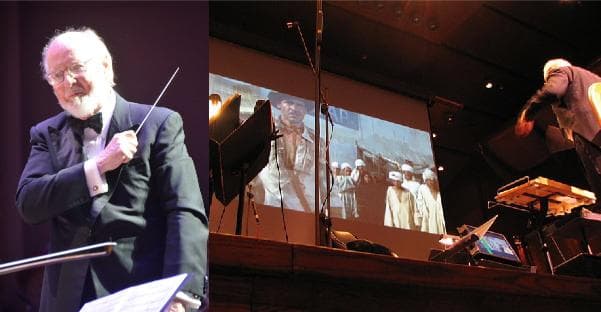
If there is one composer who has elevated the art of the leitmotif in film music, it’s John Williams. His collaborations with directors like Steven Spielberg and George Lucas have led to some of the most memorable and enduring film scores in history.
Star Wars
Williams’ work on Star Wars (1977) is often cited as the definitive example of leitmotif use in modern film. The score is a symphonic tapestry of recurring themes, each representing different characters, locations, or concepts.
The most famous leitmotif from Star Wars is undoubtedly the “Main Title” theme, often referred to as “Luke’s Theme.” This heroic brass fanfare is associated with the character of Luke Skywalker, but it also serves as a broader theme for the Jedi and the concept of heroism within the galaxy. As Luke grows and evolves as a character, so too does the use of his leitmotif, becoming more complex and varied as the story progresses.
Another standout example from Star Wars is the “Imperial March,” the menacing theme associated with Darth Vader and the Empire. The use of low brass and a driving rhythm creates an immediate sense of dread, perfectly encapsulating the power and malevolence of the dark side. As the series progresses, variations of the “Imperial March” appear in different contexts, reflecting the growing influence of the Empire and Vader’s complex character arc.
Throughout the Star Wars saga, Williams masterfully employs leitmotifs to underscore emotional beats, signal character development, and tie together sprawling narratives. Whether it’s the tender “Leia’s Theme” or the eerie “Force Theme,” every motif is carefully crafted to evoke specific emotions and guide the audience through the epic space opera.
Hans Zimmer
While John Williams is often regarded as the king of leitmotifs, modern composers like Hans Zimmer have also embraced the technique, albeit in a more subtle and often minimalist fashion. Zimmer’s scores tend to rely on textures and moods, but when he does use leitmotifs, they are incredibly effective.
The Dark Knight Trilogy: A New Approach to Leitmotifs
Zimmer’s work on Christopher Nolan’s The Dark Knight Trilogy (2005–2012) offers a fresh take on leitmotifs. Rather than creating distinct themes for each character, Zimmer often uses fragmented motifs and textures to represent their psychological states.
Take, for example, the theme for Batman. In Batman Begins (2005), the leitmotif associated with Batman starts simple, consisting of just two rising notes. This motif grows more complex and layered as Bruce Wayne embraces his role as Gotham’s protector, culminating in powerful tracks like “Molossus.” By the time we reach The Dark Knight Rises (2012), the theme has evolved even further into a full, triumphant statement, mirroring Batman’s own journey from uncertainty to heroism.
The Joker’s theme in The Dark Knight (2008) is another example of Zimmer’s innovative use of leitmotifs. Rather than a traditional melody, the Joker’s leitmotif is a dissonant, electronic sound that gradually rises in pitch, creating an unsettling sense of tension. This motif perfectly captures the chaotic and unpredictable nature of the Joker, making it one of the most memorable and effective leitmotifs in modern cinema.
Zimmer’s approach to leitmotifs is more abstract than that of John Williams, but it is no less impactful. By using music to reflect a character’s inner turmoil or the overarching mood of a scene, Zimmer is able to create an emotional connection with the audience that is both powerful and lasting.
Leitmotifs in Asian Cinema
The concept of leitmotifs isn’t limited to Western cinema; it has also found its way into the soundtracks of Korean films, where music plays a crucial role in shaping emotional and thematic elements.
In the popular Korean film Oldboy (2003), composed by Jo Yeong-wook, the use of recurring musical themes is key to underscoring the psychological tension and unraveling of the protagonist’s revenge plot. The primary theme, “The Last Waltz,” is a melancholic piece that recurs throughout the film, symbolizing the tragic fate and entrapment of the main character, Oh Dae-su. The haunting, circular nature of the theme mirrors the inescapable cycle of vengeance that drives the narrative.
Similarly, in Park Chan-wook’s The Handmaiden (2016), the recurring motifs crafted by Jo Yeong-wook help evoke the shifting power dynamics and intricate emotional connections between the characters. These leitmotifs are delicately woven into the narrative, creating a musical thread that helps guide the audience through the film’s layers of deception and manipulation.