
Polyrhythm vs Polymeter? Learn from the Music of The Matrix by Don Davis
Sep 19, 2026
All articles were written by Team Behind the Score. Some parts of the writing were polished with the help of AI to improve readability.

Both polyrhythm and polymeter combine different rhythms at once — but they do it in different ways. One pits contrasting subdivisions against each other; the other keeps the same subdivision while the phrasing cycles refuse to line up. Below we define each technique, then look at how polymeter shows up in Don Davis’s score for The Matrix and in an original composition example.
Polyrhythm vs Polymeter
Both polyrhythm and polymeter are techniques used to combine different rhythms simultaneously in music. This adds complexity and creates more interesting rhythmic patterns.
Polyrhythm
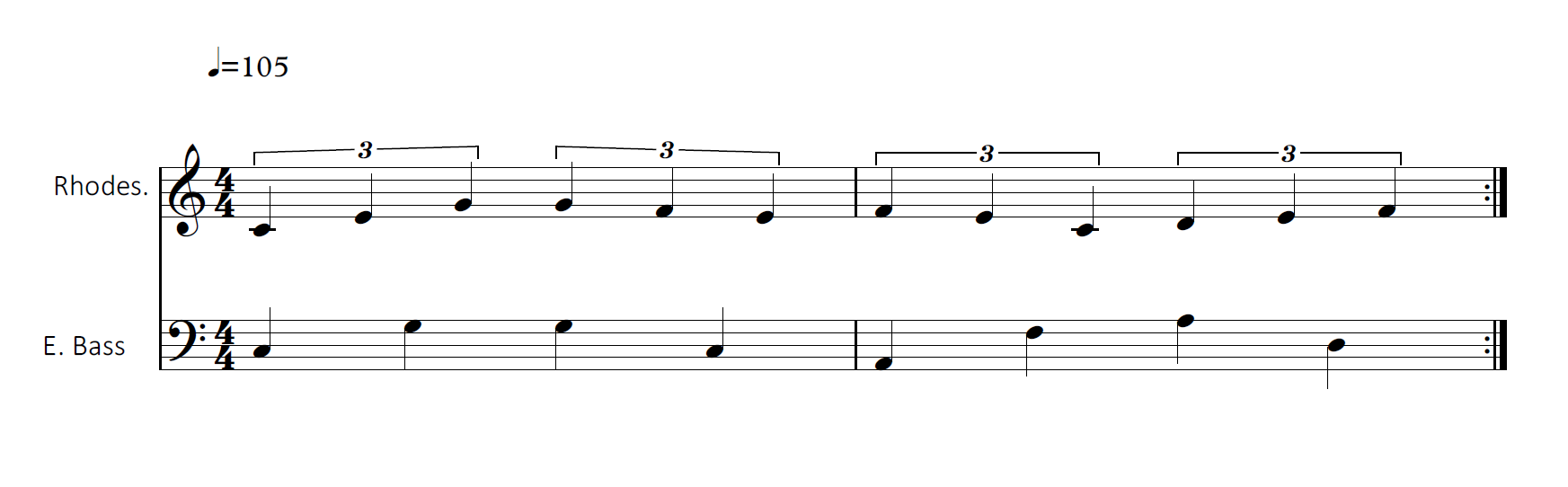
Polyrhythm involves combining two rhythms played at the same tempo within a song. Each rhythm follows its own individual subdivision pattern. For example, in the figure below, the Rhodes piano plays three quarter-note triplets while the bass plays two quarter notes within the same time span. This creates a 3-over-2 polyrhythm, where three triplets are played against the duration of two quarter notes. The Rhodes piano’s subdivision is based on quarter-note triplets, while the bass follows a subdivision of regular quarter notes. For more score examples (Debussy, John Williams, and modern 4:3 figures), see What Is a Polyrhythm? Learn with Musical Examples.
Polymeter
Polymeter is another way of combining two rhythms played simultaneously at the same tempo, but in this case both rhythms share the same subdivision pattern. In the figure below, both the Rhodes piano and electric bass play rhythms based on quarter-note subdivisions. However, the Rhodes piano repeats every 5 beats, while the electric bass is grouped in 4 beats.
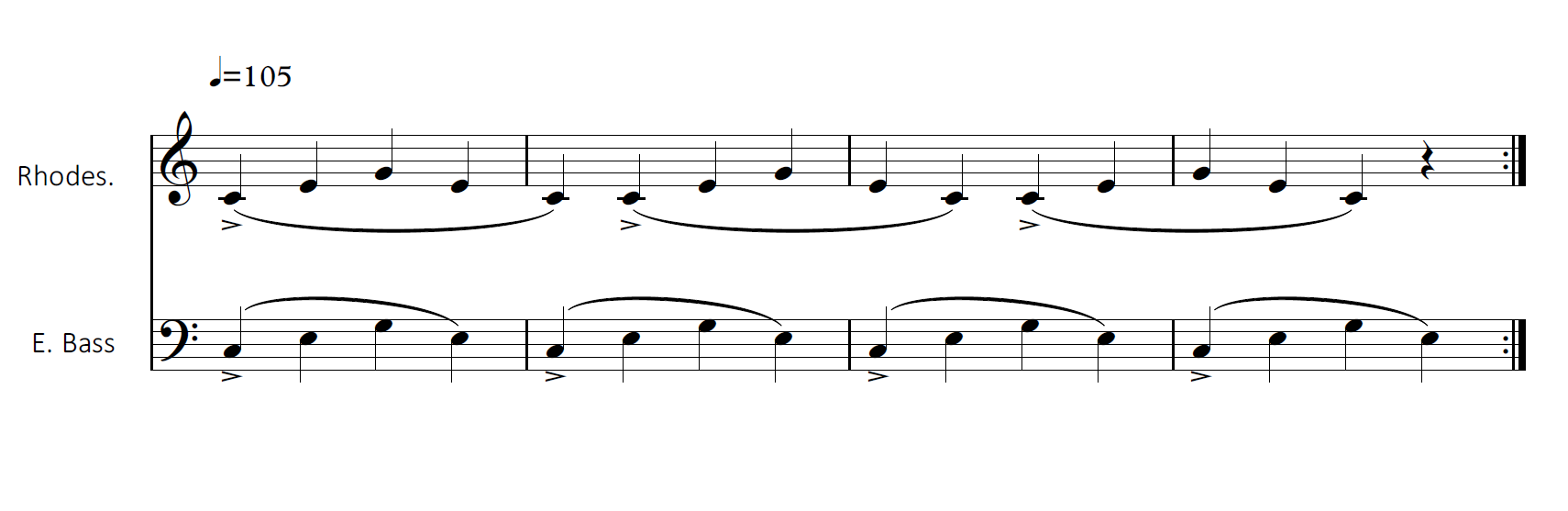
Tip — Polymeter & accent displacement: In a broader sense, polymeter incorporates the technique of accent displacement. When two rhythmic motives are played simultaneously under the same time signature, one of the motives can deviate from the notated meter by using a different set of phrasing.
Polymeter in the Music of The Matrix
The soundtrack of The Matrix is filled with an abundance of captivating rhythmic elements that perfectly serve the purpose and essence of the movie. Undoubtedly, these are among the most recommended materials for studying intriguing rhythmic techniques in film music.
The Threat Mix is a remix of the score from the 1999 film The Matrix, composed by Don Davis. It was released on the deluxe edition of the film’s soundtrack in 2000. The mix was created by Davis and electronic music producer Juno Reactor and has been praised by critics and fans alike. It has been called “a masterpiece of electronic music” and “a must-have for any fan of The Matrix.” The mix was also used in other films and television shows, including The Animatrix and Kill Bill: Vol. 1.
Don Davis, “Threat Mix,” from The Matrix (Original Motion Picture Score) (1999)
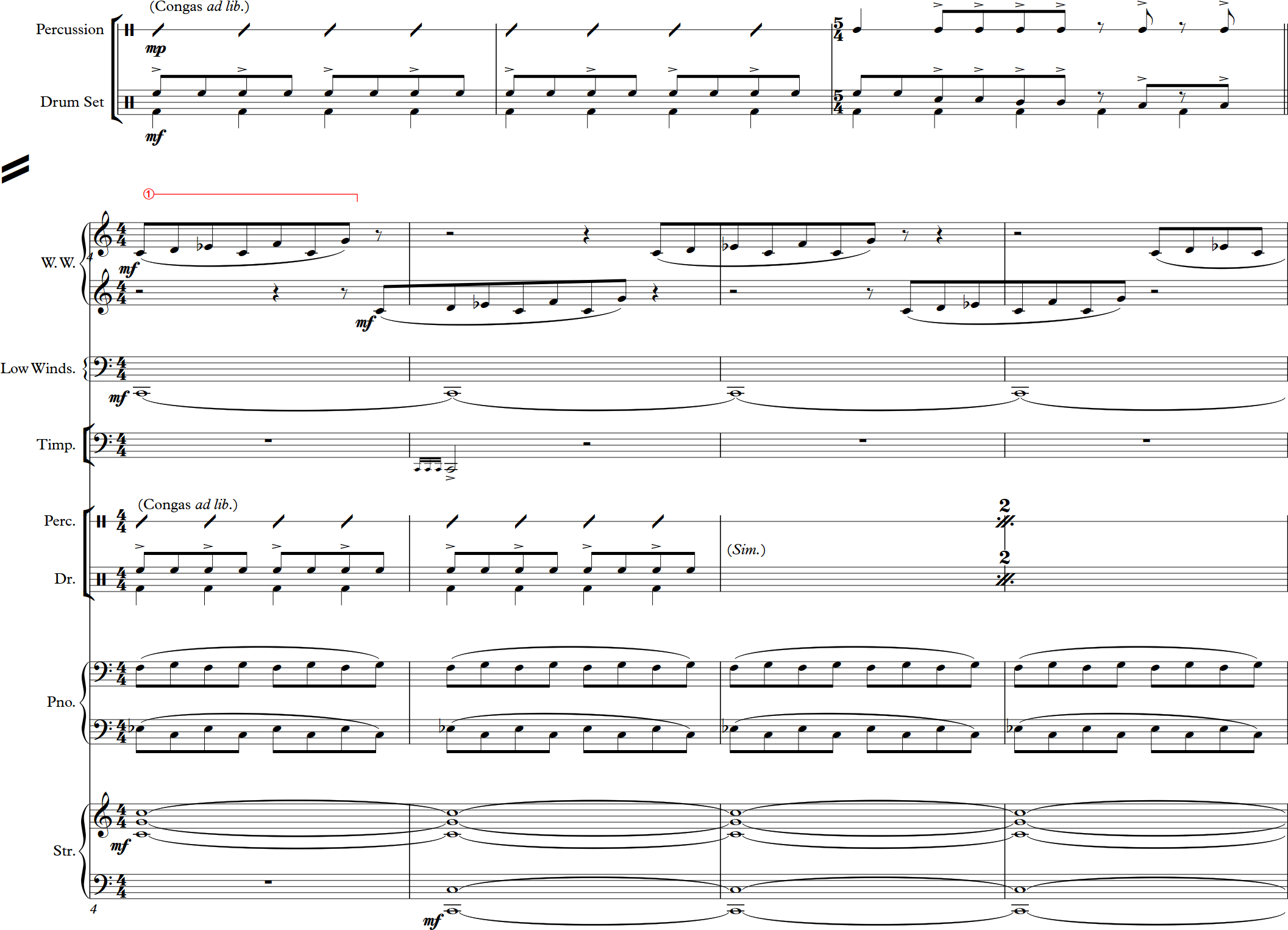
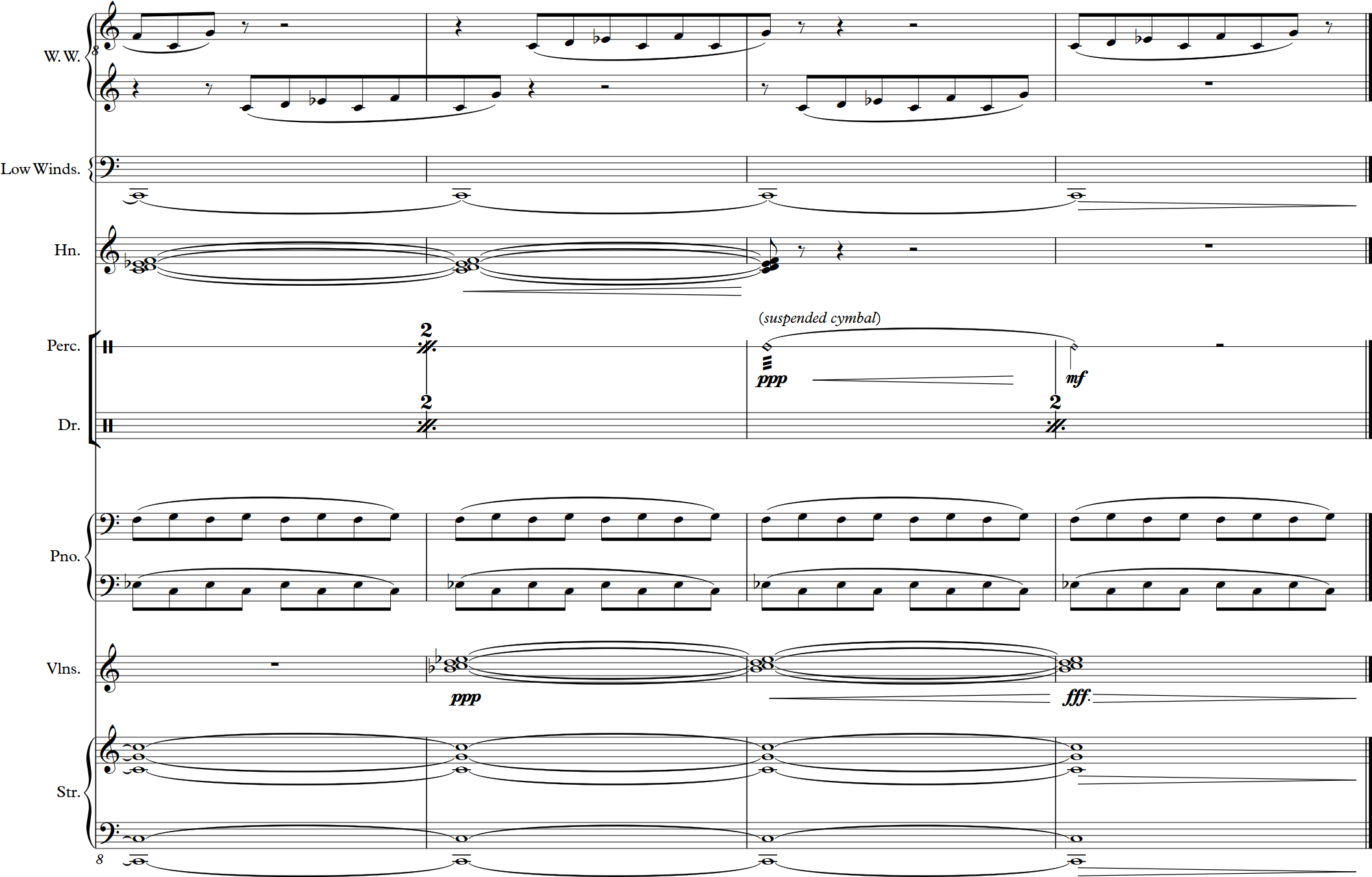
Note: Due to copyright issues, all audio and scores displayed on this page are alternative versions or recreations of the original content.
In this example, the woodwind section repeats the riff (①) which is phrased to cycle in ⅞, refusing to align with the simple meter. The rest of the instruments play straight 4/4 rhythmic figures to bring rhythmic contrast to the table. Notice how the ⅞ phrase naturally catches up with the 1st beat of 4/4 in measure 11 to give a sense of cohesiveness. This bizarre discordance was carefully crafted to convey the Matrix as a chaotic atmosphere of simulated reality.
(In the mock-up playback of this example, each ⅞ wind phrase was panned left and right to help listeners discern them better.)
Polymeter Composition Example
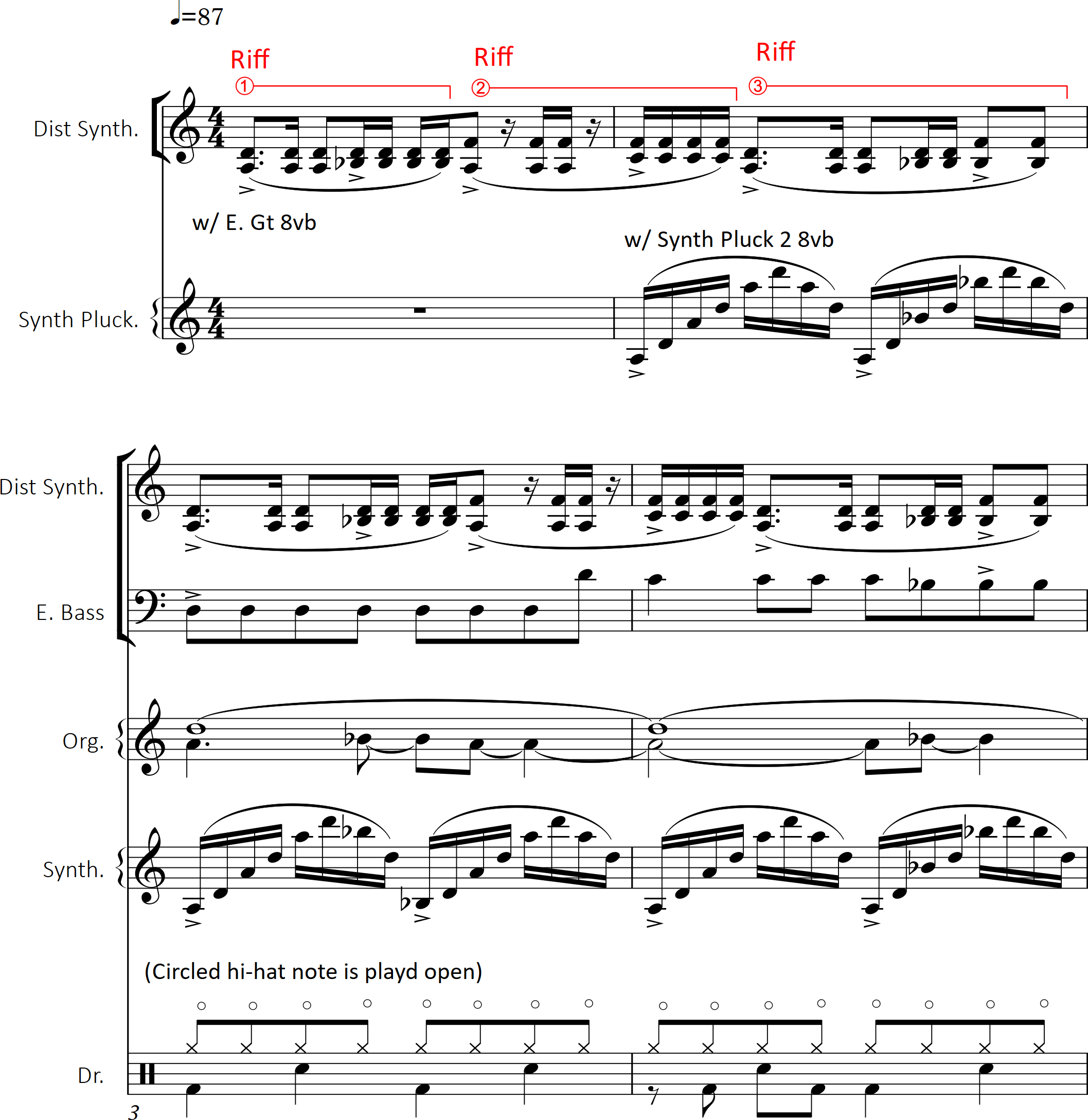
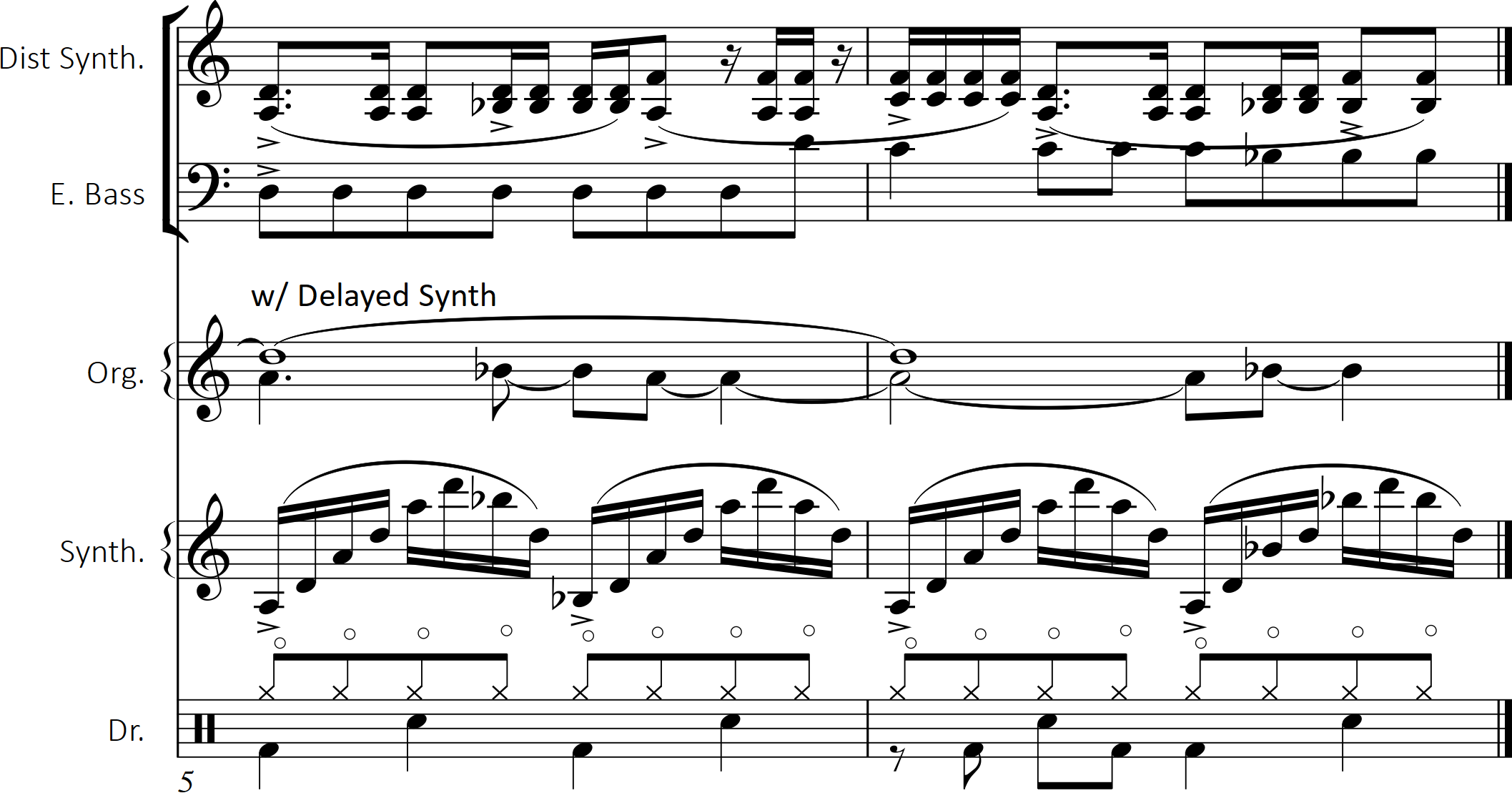
In this polymeter composition example, a distorted synthesizer (accompanied by an electric guitar playing 8vb) fills in the repeating two-measure riff with two ⅝ figures and one 6/8 figure. These figures have the same duration as two measures of 4/4 time, which is equivalent to 16 eighth notes.
Initially, with only the distorted synthesizer and electric guitar in the background, the first two repetitions of the riff (labeled as ① and ②) create a ⅝ time feel, while the third repetition (labeled as ③) produces a 6/8 feel. The rhythmic contrast becomes apparent as soon as the bass and drums enter at measure 3 and establish a straight 4/4 rhythm. As a result, the music exhibits an interesting rhythmic complexity, but all phrases in the music are still based on eighth-note subdivisions.
In the background, the synth pluck maintains a 4/4 time-based arpeggio. The figure below provides a two-bar example that illustrates the rhythmic groupings of the distorted synthesizer and electric guitar.

Closing
That sums it up. We hope this resource has been helpful in expanding your knowledge of polyrhythm and polymeter in music. We’ll continue to share articles on rhythm in media music composition — stay tuned.