
Analyzing the Ithaca Theme from The Odyssey (Ludwig Göransson)
Nov 2, 2026
All articles were written by Team Behind the Score. Some parts of the writing were polished with the help of AI to improve readability.
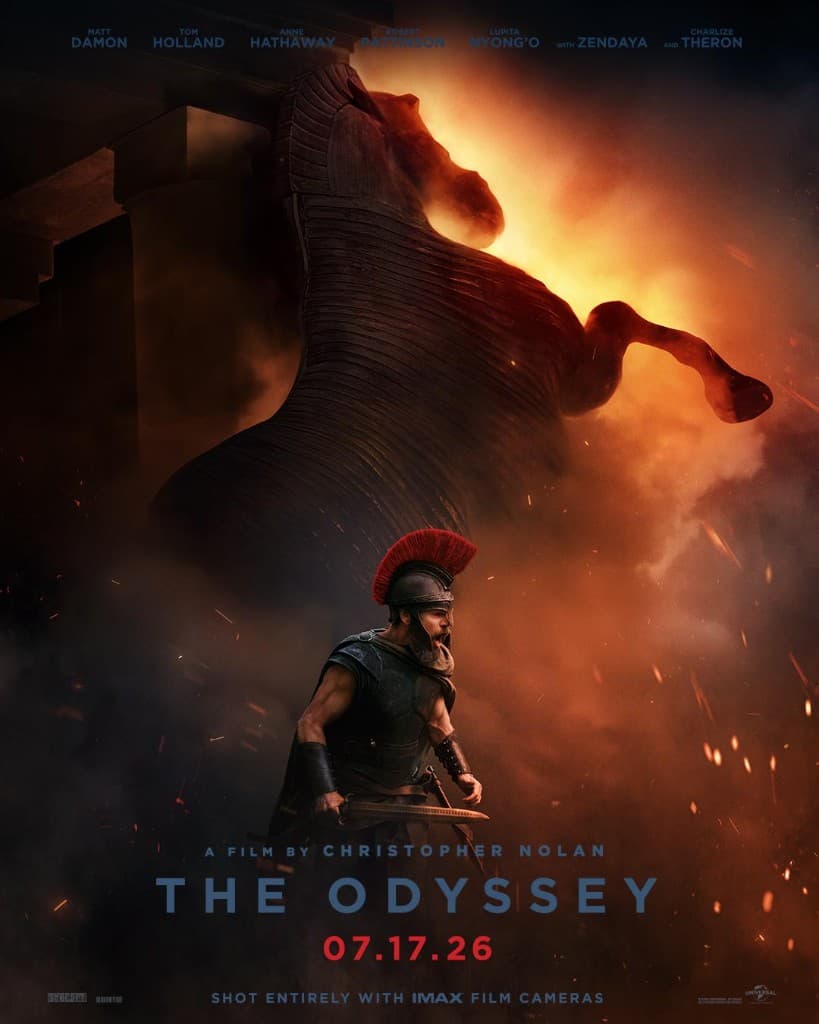
Christopher Nolan and Ludwig Göransson have done it again. After Tenet and Oppenheimer, The Odyssey is their third film together, and the score doesn’t sound like anything either of them has done before.
I’d like to analyze one of the themes from the soundtrack to The Odyssey, composed by Ludwig Göransson. But first, a couple considerations.
The Setting
Let’s think about the setting. Homer’s The Odyssey was written around the 8th century BCE. The story takes place in ancient Greece, after the mythical Trojan War in the Bronze Age (around the 12th to 13th century BCE).
Christopher Nolan asked Göransson to write the score without using any orchestral instruments (violins, horns, etc.). As Göransson put it, “It’s not like the orchestra existed back then.” So, he opted to use instruments from that general time period: mainly the aulos, a double-clarinet type instrument from the 5th or 6th century BC; and the lyre, which is both strummed and plucked. His score also incorporates voice, gongs, various percussion, and synth/processed sounds.
Göransson has called the aulos “the most popular rock star instrument for a thousand years.” Not a single original reed has survived, though, so aulos player Callum Armstrong had to work out how they were made from ancient sources and a lot of trial and error. You can see the instruments in action in this short featurette:
Writing For a Period Film
Whenever I use period instruments in a film, I find myself wondering how “true” I should stay to the musical tradition (and time period) that they come from. Unfortunately, we don’t have any recorded music from these ancient time periods. A few fragments of notated Greek music do survive on stone and papyrus, but they come centuries after Homer, and scholars still argue about how they actually sounded. But even if we knew the musical traditions, how much would we lean into them? After all, even though the film is set in Ancient Greece, the music is meant to be heard by a modern audience.
If you’re curious what researchers think ancient Greek music sounded like, this video from Oxford is a great place to start:
Take a moment and think how you might write music for a film like this set in Ancient Greece? How would you approach this, and what kind of choices might you make?
Ithaca Theme
Let’s look at the Ithaca theme, the “home” theme which recurs from time to time. It’s about as close to a main theme as this score gets, and it comes back at key moments whenever Odysseus’s journey turns toward home. Listen along here:
The recording begins with the aulos, which sounds like a pair of woodwinds: one sustains a D pedal tone, and the other moves expressively up and down, essentially riffing on what sounds like a pentatonic scale. Around 19 seconds in, the melodic flute shifts to a D pentatonic scale.
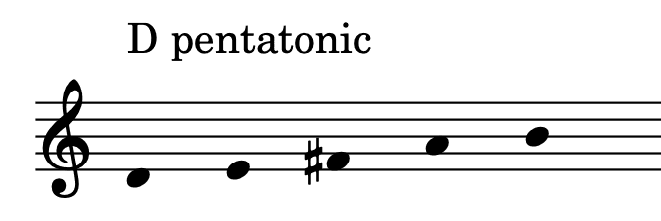
Five notes, no half steps. That’s a big part of why it sounds so open, and to our ears, so “ancient.”
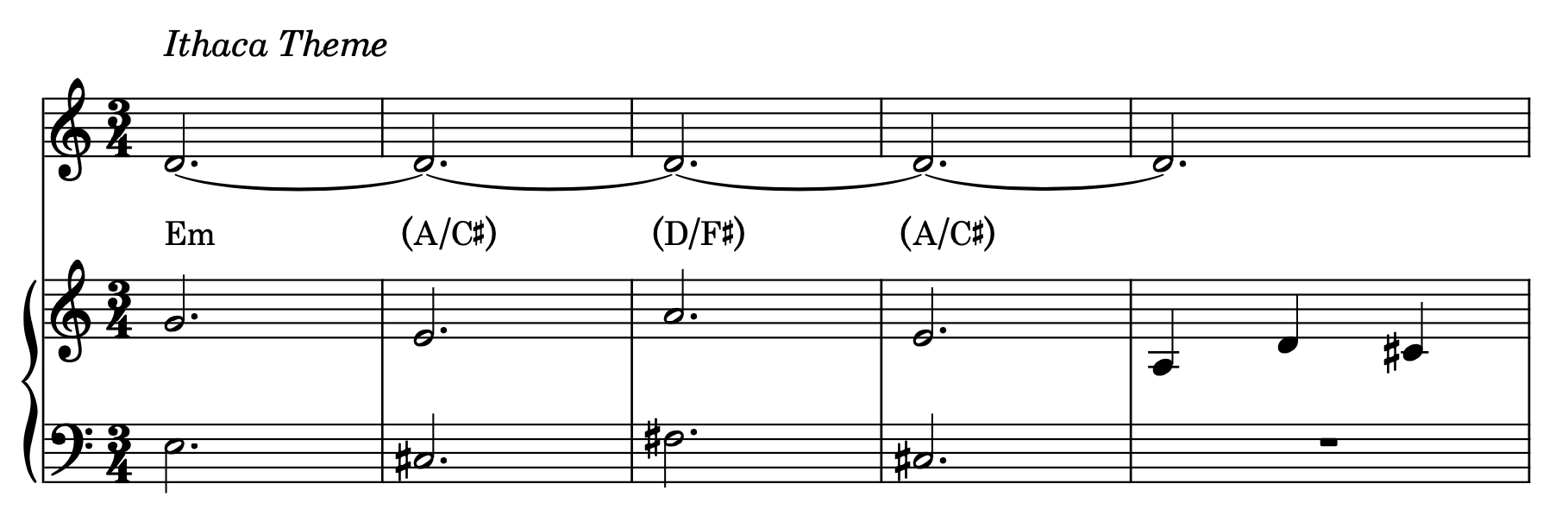
As the piece progresses, the composer adds a layer of bass and melody using the lyre (or perhaps a pair of lyres). I’ve transcribed the theme here, with a drone D written above, and the implied harmonies in parentheses, notated above the melody and bass.
Hearing It as a Chord Progression
To my modern ear, I can’t help hearing this as a chord progression. If I analyze these harmonies through the lens of contemporary music theory, the first “chord” sounds to me like E minor: the root (E) in the bass, the 3rd (G) in the treble, and the D drone sounds like a minor 7th. At the same time, we can’t forget about the pentatonic aulos riffs that weave in and out. They provide us with some critical scale tones: 1-2-3-5-6 (in other words, D-E-F#-A-B).
Notice the tension in the 2nd and 4th “chords” — the bass C# conflicts with the D drone. To my ear, this dissonance creates a sense of yearning; musically, we want the tension to resolve, but dramatically, perhaps we’re longing to get back home. In any case, tension is always useful for storytelling.
The A/C# harmony feels implied to me — while there’s no explicit A in the treble or bass, we hear A in passing from the aulos riffs. With that context, we get a rather modern harmony from the combination of D, E, implied A, and C#. It sounds to me a bit like Dsus2/C#.
In the 3rd measure, we get a clear D/F# chord, with the 3rd (F#) in the bass, the 5th (A) in the treble, and the root (D) coming from the drone note. And at the very end, three melodic notes: A, D, and C#. Once again, the C# against the D drone creates a yearning, and an expectation to resolve. The theme never quite gets there, which feels about right for a man who spends ten years trying to get home.
Final Thoughts
I find it compelling to hear the color of these ancient instruments rendered in contemporary harmonies with sophisticated dissonance. In this way, Göransson creates something truly unique for this film.
Next time you watch The Odyssey, listen for that D drone and the C# rubbing against it. Once you notice it, you’ll start hearing it every time the story turns toward Ithaca. If you’d like to dig further into recurring themes like this one, take a look at our article on leitmotifs in iconic film soundtracks.